Condition
Laminitis in horses
A clinical guide to equine laminitis: what happens inside the hoof, why the coffin bone rotates and how our 3D laminitis horseshoes help.
Laminitis is a condition that can affect all horses, ponies and donkeys. It is an inflammation of the laminae, the tissue that keeps the coffin bone (P3) attached to the inner wall of the hoof.
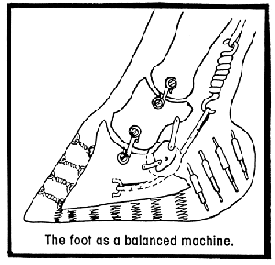
When the laminae become inflamed, they weaken and stop properly supporting the tension exerted by the deep digital flexor tendon on P3. As a result, the coffin bone can separate from the inner hoof wall and rotate.
To understand it better, we can imagine the laminae as a velcro system. When that "velcro" loses strength, it ends up separating due to the constant pull of the deep digital flexor tendon.
Another simple way to visualize it is to think of the coffin bone as a joystick held in position by the balance between two forces: the laminae on one side, and the deep digital flexor tendon on the other. It is similar to a tug-of-war game with a flag in the middle. When the laminae team loses strength, the tendon takes over and pulls the coffin bone backward, causing it to rotate.
This rotation causes the tip of the bone to significantly increase pressure on the solar corium, the structure responsible for producing the sole of the hoof. As a result, blood flow in that area decreases, preventing normal sole growth.
For this reason, the main goal in treating laminitis is to restore blood flow as soon as possible. Only then can the sole needed to return the coffin bone (P3) to its position be produced again.
Speed of action is essential. The sooner blood circulation is restored, the lower the chances of necrosis appearing, one of the greatest enemies of laminitis. When tissue dies, recovery becomes much more complicated.
Horses with laminitis often develop numerous abscesses precisely for this reason. The body needs to eliminate dead, necrotic or infected tissue. Therefore, the appearance of abscesses in a laminitic horse provides important information about the process occurring inside the hoof.
The horseshoes we use are not a magic solution, but they are a very important aid. Their design allows reducing the traction of the deep digital flexor tendon on the coffin bone by up to 60%, partly balancing the battle between the laminae and the tendon.
By reducing the tension exerted by the tendon, the pressure of the bone tip on the solar corium is also reduced. This favours the recovery of blood flow and promotes the growth of a healthy sole, an essential step for the horse's recovery.
Reduction of deep digital flexor tendon traction
Our horseshoes help balance the battle between laminae and tendon, reducing pressure on the solar corium.