Condition

The importance of sole depth in laminitis in horses

Sole depth is one of the most important factors in the treatment and recovery of laminitis in horses. The sole not only acts as a protective barrier between the ground and the internal structures of the hoof, it also plays a fundamental role in protecting the coffin bone or third phalanx (P3).

When a horse develops laminitis, the laminae that suspend P3 inside the hoof capsule can suffer significant damage. At that point a real biomechanical battle begins between the damaged laminae and the deep digital flexor tendon, which pulls on P3.

The aim of treatment must be to reduce harmful forces, protect the internal structures and create the conditions the hoof needs to progressively rebuild sufficient sole depth.

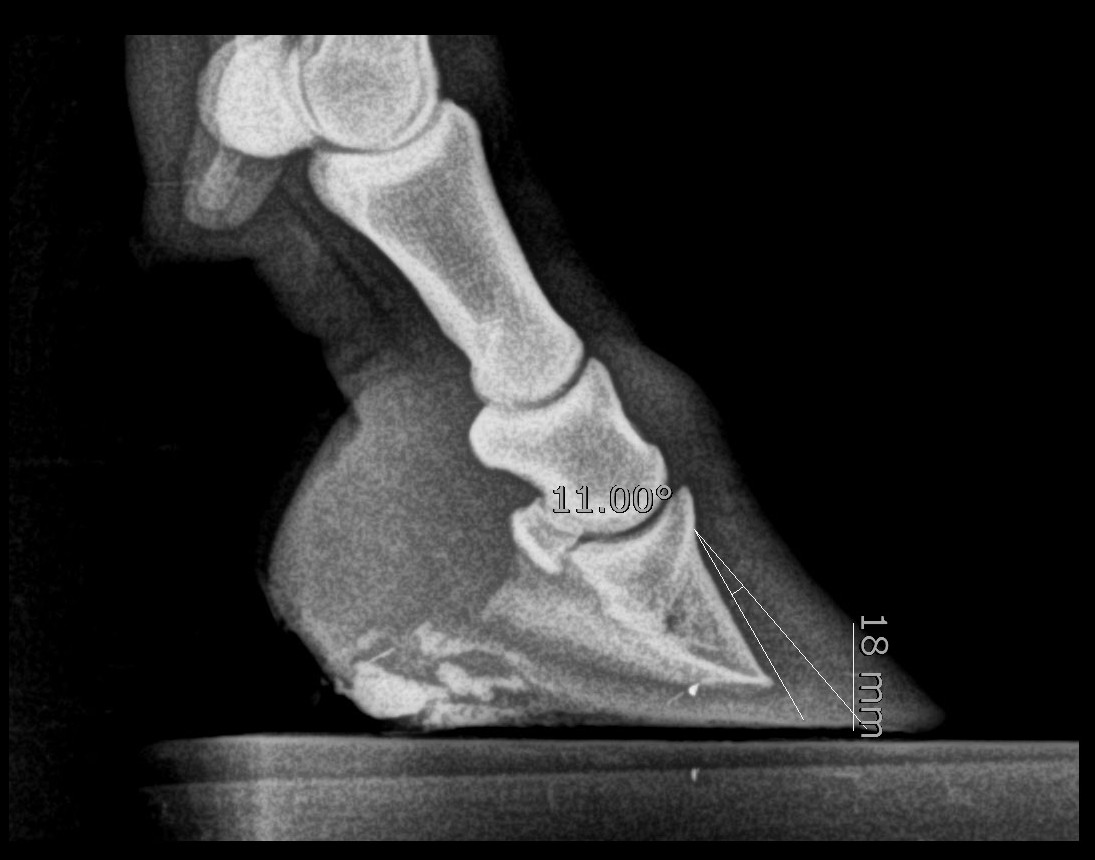
Lateromedial radiograph of a chronically laminitic hoof showing 11 degrees of P3 rotation and 18 mm sole depth
Initial radiograph: 11° P3 rotation and sole depth reduced to 18 mm. The tip of the coffin bone approaches the solar surface and pressure on the corium increases.
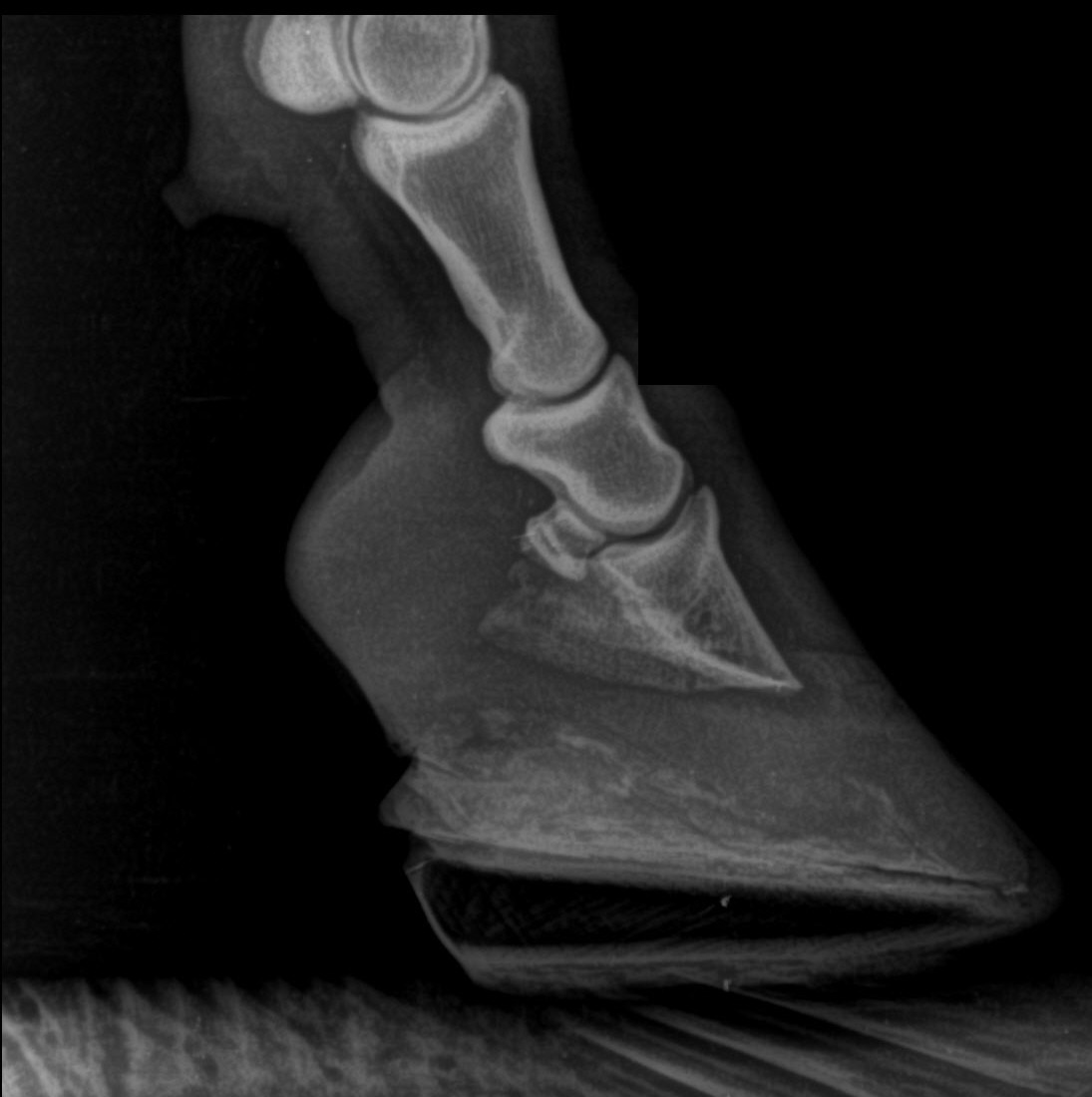
Lateromedial radiograph of the same hoof with a 3D-printed laminitis horseshoe and restored sole depth
Follow-up with the 3D-printed laminitis horseshoe: sole depth restored and P3 repositioned, with greater protective distance between bone and ground.

The sole protects the coffin bone (P3)

The role of the sole goes far beyond bearing the horse's weight. Its depth provides physical protection between P3 and the ground, especially in the toe region of the hoof.

When sole depth is adequate, the horny tissue helps protect the solar corium and the internal structures from the forces generated during weight bearing.

There is another particularly important aspect in horses with laminitis: restoring sole depth can help create the conditions for P3 to progressively return towards a more favourable position within the hoof capsule.

When the forces acting on P3 are correctly redistributed, the damaged laminae have the opportunity to recover and re-establish a healthier functional connection between the hoof wall and the bone.

So laminitis rehabilitation is not only about growing more hoof. It is about growing new tissue under the best possible conditions so that it once again provides protection and stability to P3.

What happens when P3 rotates in a horse with laminitis?

When the laminae lose part of their capacity to hold P3 in position, the bone can displace within the hoof capsule.

Where P3 rotation occurs, the tip of the coffin bone can come considerably closer to the solar surface. As a result, pressure increases on the solar corium, the vascular tissue responsible for producing the sole.

This can generate a particularly damaging cycle: laminitis → laminar damage → P3 displacement → increased pressure on the solar corium → vascular compromise → less sole production → less protection for P3.

The thinner the sole remains, the less protection there is between the bone and the ground.

Pressure from P3 on the solar corium can limit sole growth

The solar corium needs an adequate blood supply to produce new horny tissue. Blood delivers the oxygen and nutrients required to maintain the activity of the tissues that form the sole.

When the tip of P3 exerts excessive pressure on this area, circulation can be compromised. If that pressure is significant enough and persists over a prolonged period, blood supply can decrease considerably.

In the most severe cases this can limit or even temporarily stop the production of solar tissue.

This loss of protection can favour serious complications such as:

  • Penetration of the sole.
  • Injury and necrosis of the solar corium.
  • Remodelling of P3.
  • Persistent vascular damage.
  • Permanent alterations to the internal structures of the hoof.
  • Pain and difficulty regaining comfortable weight bearing.

For this reason, restoring sole depth should be considered one of the fundamental objectives in the treatment of equine laminitis.

Vascularisation is essential to restore the sole

For the sole to grow correctly again, the solar corium needs adequate vascularisation.

Blood must be able to reach the areas that have been under the greatest pressure and deliver the nutrients the tissues need to recover their function. This is especially important where there is a zone of maximum pressure beneath the tip of P3.

The aim of treatment should not simply be to wait for the sole to grow. It is necessary to create the mechanical conditions that allow circulation to recover and favour the production of new horny tissue.

When vascularisation improves, nutrients can reach the hoof-producing tissues again and sole formation can progress. Restoring sole depth is therefore closely linked to vascularisation, biomechanics and hoof management.

How fast does a horse's hoof grow?

Under normal or favourable conditions, a horse can produce approximately 10 mm of hoof and sole per month.

However, this figure should not be read as a guaranteed growth rate. Hoof production can vary considerably depending on factors such as vascularisation, corium health, metabolism, nutrition, horny tissue quality and the horse's general condition.

In a horse that has suffered laminitis and shows vascular damage or significant injury to the solar corium, growth can be considerably slower. Restoring a very thin sole can therefore take several months and, in some cases, several complete hoof growth cycles.

How much sole depth does a horse need?

Sole depth is a key parameter for assessing hoof protection. As a practical reference, at least around 15 mm of sole is considered necessary for a horse to show a certain degree of comfort, with or without an associated pathology.

This value should be understood as an indicative minimum, not a universal figure applicable to every horse. Hoof conformation, P3 position, sole quality, the surface the horse moves on and its clinical status also directly influence comfort.

In a horse with laminitis, reaching adequate sole depth can be especially important because it increases the protective distance between P3 and the ground. The greater the available solar protection, the less the internal structures are directly exposed to loading forces.

The role of mechanical shoeing in laminitis

Mechanical shoeing for laminitis plays a fundamental role in supporting this process. When the laminae are damaged, the hoof is subject to forces that can hinder recovery: the laminae must hold P3 within the capsule, while the deep digital flexor tendon pulls on the bone.

The result is a genuine mechanical battle between the damaged laminar structures and the forces acting on P3.

The aim of shoeing must not simply be to place a shoe under the hoof. It must seek a redistribution of forces, reducing those that are harmful and favouring mechanical conditions more suited to recovery. Therapeutic shoeing in laminitis must therefore be designed around the individual biomechanics of each hoof.

Shoeing, vascularisation and sole growth

The ultimate objective is not only to make the horse more comfortable immediately after shoeing. A sound mechanical strategy must aim to create the conditions the internal structures need in order to recover.

If we can redistribute forces, reduce pressure on the solar corium and improve loading conditions, we can support the recovery of vascularisation in the area.

And when the corium receives an adequate supply of blood and nutrients again, it can progressively recover its capacity to produce horny tissue. In this way mechanical shoeing can form part of a strategy aimed at promoting sole growth and progressively increasing the protection of P3.

Why is it important to measure sole depth?

In a horse with laminitis, assessment should not be limited to the degree of P3 rotation. It is also necessary to know how much tissue lies between the bone and the ground.

Hoof radiographs allow a more precise assessment of:

  • Sole depth.
  • The position of P3.
  • Rotation of the coffin bone.
  • The distance between P3 and the solar surface.
  • The relationship between P3 and the hoof capsule.
  • How the hoof evolves during treatment.

Radiographic monitoring during rehabilitation makes it possible to confirm whether sole depth is increasing and whether internal hoof conditions are improving.

Sole recovery is a process, not an immediate result

A horse with laminitis does not rebuild a thin sole overnight. If normal growth is around 10 mm of hoof and sole per month under favourable conditions, reaching adequate sole depth takes time. Where vascular damage or corium injury exists, growth can be slower still.

Treatment must therefore be planned over the medium and long term. The goal is for every new millimetre of growth to contribute to rebuilding a more protective, stable and functional structure.

The circle of protection: more sole, more protection for P3

Restoring sole depth can become a key element in the rehabilitation of the laminitic horse. When pressure on the solar corium is reduced and its vascularisation recovers, the tissue can start producing new sole.

More sole → greater protection for P3 → less pressure on the corium → better conditions for vascularisation → greater capacity to produce sole → recovery of P3 position within the hoof → recovery of the damaged laminae.

The goal is to break the negative cycle caused by laminitis and establish a progressive recovery process.

Conclusion: restore the sole to protect P3

The importance of sole depth in laminitis is directly related to protection of the coffin bone and to the hoof's ability to recover adequate function. When P3 rotates, its tip can press on the solar corium and compromise its vascularisation. If circulation is affected, sole production can decrease, leaving the bone even more exposed to ground forces.

One of the fundamental objectives of treatment must therefore be to restore vascularisation in the area, promote sole growth and progressively increase protection of P3. A horse can produce around 10 mm of hoof and sole per month under normal or favourable conditions, but reaching a protective depth takes time: as a minimum reference, roughly 15 mm of sole may be needed to achieve a certain degree of comfort.

Mechanical shoeing for laminitis plays an essential role in this process by redistributing forces between the damaged laminae and the deep digital flexor tendon, protecting the internal structures and favouring better conditions for corium recovery and sole growth. Ultimately, treating laminitis is not only about controlling the position of P3: it is also about protecting it and creating the conditions the hoof needs to rebuild the sole that protects it.